Supercharge Your Second Brain (Without Making a Mess)
I used to treat my vault like bulk storage. Capture more notes. Save more links. Build a bigger system. But inevitably this system would same wall every time - too much stuff, quality all over the place, and endless searches through vaguely titled notes to find exactly what I needed.
Agents made this worse before they made it better. They’re fast. They can generate mountains of text and scaffold projects in seconds. But if your system is vague, agents just help you produce vague output faster.
What changed for me was treating the vault less like a library and more like an operating system. An OS has a few properties worth stealing:
- A single source of truth for behavior
- Inputs get routed to the right place
- Active work has a stable state
- Review has a clear surface and clear stop conditions
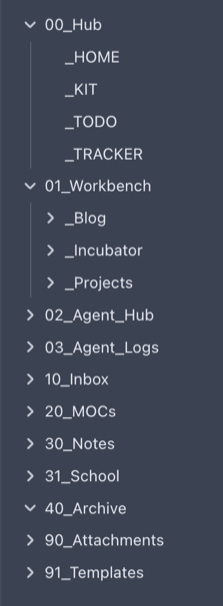
In practice, that means the vault needs contracts. Agents need to know what to read first, where they’re allowed to write, and when they have to stop and ask. Without that, every agent run becomes a new interpretation of your vault, and the whole thing drifts a different direction each time.
Projects need stable surfaces too. If a project is active, it should have a small set of notes doing different jobs - requirements, navigation, tasks, decisions, agent rules. Not bureaucracy. Just enough structure that both you and your tools can find things.
Stage separation mattered more than I expected. Not every idea belongs on your active TODO list. Some things are incubating. Some need a spec before you commit. Some are in a writing pipeline. Once I separated those, my TODO list got quieter and the vault got calmer.
The last piece is review bandwidth. Once agents are involved, your bottleneck isn’t typing anymore. It’s review. A good setup makes review cheap: output lands in the right place, the change is scoped, assumptions are stated, and the agent stops when it should.
Build your vault around that loop and agents don’t turn it into chaos. They speed up a system you already trust.